Contents
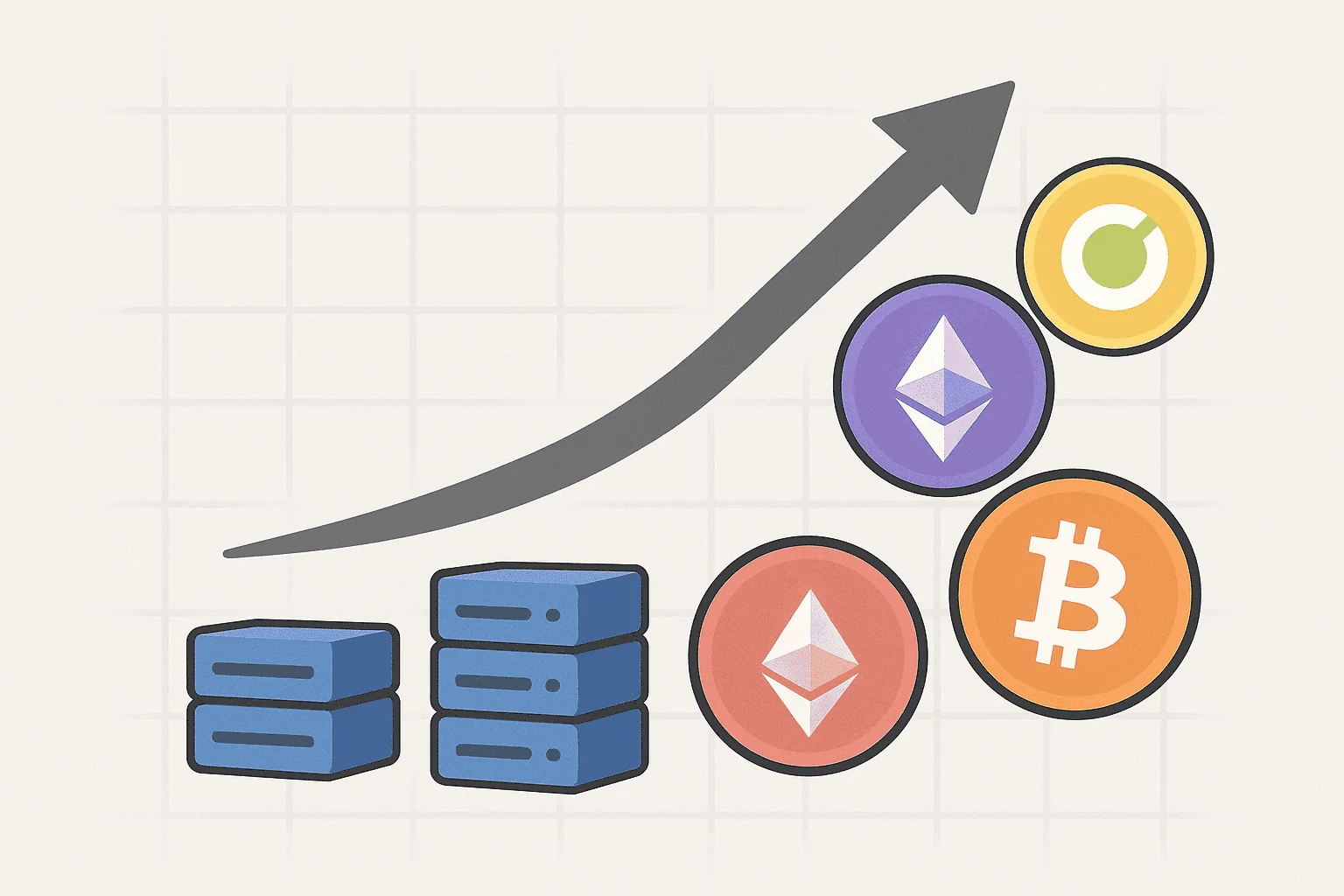
Decentralized Physical Infrastructure Networks (DePIN) promise a simple arc: build real-world networks with crypto incentives, then watch tokens appreciate as usage climbs. In practice, price often lags, runs ahead, or detaches entirely. Understanding why helps investors separate healthy network growth from speculative noise.
What “growth” actually means in DePIN
Growth is not one metric. It spans supply, demand, and reliability. Supply covers devices and nodes added to the network. Demand shows up as paid jobs, data requests, storage deals, compute minutes, or map tiles served. Reliability is the glue: uptime, job completion, and latency that make customers return.
Concrete examples help. Helium’s migration to Solana cut operational overhead for core logic and enabled higher throughput as the network expanded into 5G; that’s infrastructure progress, not necessarily a signal for near-term token appreciation. Render’s burn-and-mint equilibrium (BME) ties network fees to token burn/mint flows so utilization can translate into token demand more directly.
How tokens capture (or miss) value
Whether growth reaches the token depends on explicit value-capture hooks in the design. The mechanics vary by category—wireless, compute, storage, mapping—but the levers rhyme.
- Fee sinks: pay for usage in the token or convert to credits that require token burn (e.g., RNDR → Render Credits under BME).
- Collateral & bonds: storage providers or node operators post tokens, constraining float and aligning incentives.
- Staking for work: stake-to-provide or stake-to-curate models tie economic weight to service quality.
- Emission routing: rewards that taper and redirect to productive actors, not pure inflation.
- Treasury policy: buy-backs, burns, or grants that improve token flow over time.
Absent these hooks, a network can scale nicely while the token drifts. The design must convert usage into persistent demand or reduced supply.
Why price can decouple from network usage
Decoupling isn’t random. It follows well-known paths that often coexist.
- Emissions vs. demand: if rewards outpace organic usage, new supply smothers price even as devices onboard.
- Unlock schedules: investor or team cliffs release inventory into thin markets, muting fundamentals.
- Payment rails: paying in stablecoins while using the token only for staking weakens direct demand.
- Liquidity & venues: shallow order books and fragmented listings amplify volatility unrelated to usage.
- Narrative cycles: sector rotations (AI, gaming, L2s) can overshadow steady DePIN traction for months.
When several of these hit at once, even strong monthly active users (MAU) or job counts may not move the chart.
Case snapshots: growth signals vs. token design
Helium (IoT & 5G): The network migrated core activity to Solana in April 2023 to improve efficiency, then expanded 5G build-outs under a subDAO model (IOT/MOBILE). Network coverage and throughput are operational wins; token outcomes hinge on how traffic converts into HNT sinks across sub-networks.
Render Network (GPU compute): Under BME, users burn tokens into credits, while supply expands only when work is paid—aligning token flows with real rendering demand. This explicit burn-for-usage link tends to couple revenue and token demand more tightly than pure inflationary rewards.
Akash (decentralized cloud): A reverse-auction marketplace matches tenants with providers; lowest viable bid wins. This drives price discovery on compute and can attract real workloads. Token value depends on staking, fee flows, and how much market activity requires AKT to move.
Hivemapper (mapping): Contributors earn HONEY weekly for uploading fresh imagery and QA tasks. Growth shows up as more high-quality road coverage and frequent map updates; token demand relies on how map consumption and premium features loop back into HONEY sinks.
Filecoin (storage): Storage providers post collateral and earn fees and block rewards. When storage deals and retrievals accelerate, fundamentals strengthen—yet price response depends on reward schedules, provider economics, and whether clients fund deals in FIL or stablecoins.
Table: Growth signals vs. token design levers
The grid below pairs common DePIN growth indicators with the mechanisms that can translate them into token performance.
| Growth Signal | What It Measures | Token Design Lever | Likely Impact on Token |
|---|---|---|---|
| New nodes/devices | Supply capacity and coverage | Stake-to-operate; emission taper | Neutral to positive if emissions don’t flood supply |
| Paid jobs / active deals | Real demand and revenue | Burn-for-credits; fee in native token | Positive when usage requires token burn or payment |
| Utilization rate | % capacity doing paid work | Dynamic pricing; reverse auctions | Positive as fees concentrate and churn drops |
| Reliability (SLA, latency) | Service quality for customers | Slashing; QoS-linked rewards | Indirectly positive via retention and referrals |
| Ecosystem stickiness | Tooling, SDKs, marketplace depth | Treasury grants; fee rebates | Positive if it lifts recurring paid usage |
Read the table left to right: without a matching lever, growth may not hit the token. With a clear fee sink or collateral loop, even modest growth can compound value.
A practical evaluation framework
Use a simple checklist before treating “more devices” or “more jobs” as price catalysts. This reduces narrative risk and forces attention on cash-flow paths.
- Trace the fee: identify how customers pay, with what asset, and where that fee goes (burn, treasury, validators).
- Quantify sinks: list actions that require the token—credits, staking, collateral—and estimate potential weekly demand.
- Model emissions: map the next 6–12 months of rewards, unlocks, and programmatic inflation against expected demand.
- Check liquidity: review market depth and venue coverage; thin books distort fundamentals.
- Verify real demand: prioritize metrics that imply willingness to pay: paid compute minutes, storage deals, map tile calls, data transfer.
- Stress-test with scenarios: ask what happens if demand stalls for a quarter: do emissions overwhelm sinks?
Even rough numbers clarify which catalysts matter and which are marketing gloss.
Tiny scenarios that expose the gap
Scenario A (decoupling): A wireless DePIN onboards 20k gateways in two months. Rewards expand to attract installers, but paid traffic is still pilot-scale. Token emissions exceed sinks. Price hesitates despite the map turning green.
Scenario B (coupling): A GPU network integrates with a popular AI inference framework. Jobs are paid in credits that require token burn. As job count and average job size rise, net circulating supply drops. Token tracks revenue more closely.
Signals worth tracking weekly
Most dashboards drown you in counts. Focus on the few that predict cash flow and capture.
- Paid usage: jobs, deals, or minutes with verified receipts.
- Net token flow: emissions minus burns, fees, and collateral locks.
- Utilization: how much capacity earns; idle capacity is dead weight.
- Churn & reliability: customer retention, SLA breaches, dispute rates.
- Roadmap to sinks: upcoming changes that add burns or required staking.
When these trend in the right direction together, token performance more often follows.
Putting it together: growth ≠ price—unless design makes it so
DePIN momentum is real: more networks ship hardware, sell compute and storage, and collect real fees. But tokens only benefit when fee paths, sinks, and emissions align. Helium shows how scaling infrastructure and migrating to a high-throughput chain can improve operations; Render demonstrates how explicit burn mechanics tie work to the token; Akash and Filecoin reveal how auctions and collateral can structure supply and quality; Hivemapper highlights contributor incentives and weekly reward
For research, start with the fee path, then the sinks, then emissions. If those three line up—and paid usage is rising—the token has a fighting chance to reflect growth rather than fight it.